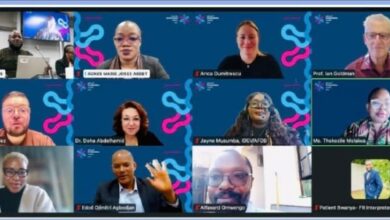
Economic Media in the Age of Hybrid Warfare: An Action Agenda for Egypt

Dr. Doha Abdel Hamid,
International Economic Policy Expert
In 1986, American scholar Frank Hoffman described hybrid warfare as “a simultaneous combination of conventional and unconventional tools, including economic, informational, and psychological warfare, aimed at exhausting the adversary without direct confrontation.” When NATO formally adopted this concept in its 2010 Strategic Concept document, it was not describing a hypothetical future — it was framing a reality that many states had already come to live. Egypt today is no exception.
What the region has witnessed since October 2023 is not a conventional war between opposing armies, but an integrated system of pressures — military, economic, media-driven, and psychological, all at once. In precisely this context, the fundamental question becomes: how does economic media fulfil its role in confronting these wars? How does it protect the home front — not through silence, not through exaggeration, but through accurate information, sound analysis, and a discourse that inoculates and fortifies?
The Economic Targeting of Egypt: Nothing Is Coincidental
For anyone who contemplates the map of economic pressures on Egypt over recent decades, it is difficult to view them as fragmented or random. The Grand Ethiopian Renaissance Dam (GERD) — in which other countries have remained partners in financing and technical planning since its early stages — constitutes in itself a model of what is known as “structural pressure”: the targeting of strategic resources rather than borders. According to estimates from Egypt’s Ministry of Water Resources and Irrigation, the potential decline in water levels ranges between 12 and 25 billion cubic meters per year over the long term, threatening more than 80% of irrigated agricultural land.
On the other front, the Middle East wars have struck another economic artery. Suez Canal revenues reached their peak at approximately $9.4 billion in fiscal year 2022–2023, then sharply declined to below $4 billion in 2024, before falling further still with the outbreak of the latest conflict with Iran in 2026 — the result of intermittent closures and security risks that periodically divert global shipping away from the Red Sea to avoid the threats posed by the Bab el-Mandeb and Hormuz straits. Since the Suez Canal represents one of Egypt’s four primary sources of foreign currency — alongside tourism, remittances from Egyptians abroad, and foreign direct investment — this decline is not merely a figure in a budget; it is a seismic shock to the structure of external balance.
These pressures come in the context of external debt that has reached $162 billion, and inflationary pressures that are eroding the purchasing power of broad segments of the population. It is precisely here that hybrid warfare reveals its informational face: when the citizen is anxious and exhausted, he/she becomes vulnerable to any well-crafted narrative that offers him a ready-made explanation for the crisis.
Warfare in the Information Space: Strategies and Tools
Information-economic warfare does not operate by fabricating facts outright — that is too easily exposed. It operates, fundamentally, through three mechanisms that are far more subtle and damaging:
The first is the selectivity of facts: publishing a figure that is entirely accurate but stripped of its context. An inflation figure without a regional comparison; an exchange rate without reference to the recovery of reserves; a decline in Suez revenues without mentioning the obvious regional causes. A recipient who lacks context cannot distinguish news from weaponized information.
The second is exploiting a real crisis to amplify a sense of loss of control: when commodity prices rise, tweets spread that do not discuss the cause but instead plant a single question: “Where are we headed?” When that question recurs without an answer, it produces a social despair that is itself a strategic objective.
The third is the amplification of internal division: social, sectarian, and generational fault lines are magnified and exploited to convince public opinion that society is collapsing from within. This message is directed simultaneously at the foreign investor, the tourism sector, and international creditors.
The response to this warfare is not silence, nor bare denial — it is what can be called proactive transparency: having official bodies be the first to announce the difficult figure, coupled with its analysis, its context, and a plan for addressing it. A figure that the government announces first is stripped of its utility as a weapon in the adversary’s hands.
The Operations Room: A Model for Real-Time Response
States with mature economic media have come to rely on what are known as “information operations rooms” — permanent units within decision-support centers composed of economic experts from both the public and private sectors (ideally including an independent voice of established public credibility), alongside specialists in digital space monitoring and journalists trained in crisis communication.
The mission of this room is not to issue statements but to read the informational landscape in real time: What economic rumor is currently circulating? Where did it originate? How widely has it spread? What is the optimal response and at what timing? A delayed response in an information crisis is functionally equivalent to silence.
Egypt benefits from a distinguished media operations room that responds in real time to rumors through the platforms of its Information and Decision Support Centre.
Informational Transparency: From the State’s Right to Its Duty
There is a fundamental matter that we have long deferred addressing: restoring professional standing to the role of the media adviser within ministries and economic institutions that have the greatest impact on citizens’ lives. It is not sufficient for such an adviser to inform us that “the minister met with such-and-such delegation.” What is required is that every press release answers three questions: What did we decide? Why? And how does this decision affect the citizen’s daily life? Indeed, a dedicated budget should be allocated for regular press and media conferences.
The genuine economic news item is one that connects a decision to raise interest rates to its effect on the monthly mortgage payment; a decision to subsidize wheat to its reflection in the price of bread; a trade agreement to what it means for the worker in the relevant sector. This is not journalistic luxury — it is the very essence of what informational transparency means as an institutional policy.
The matter becomes more urgent when we recognize that the absence of this functional media does not leave the space empty — others fill it. There is therefore a pressing need for clear legislation that regulates the right of access to economic information transparently or the long-awaited information dissemination act, obliging government bodies to make periodic disclosures according to unified standards — something many countries in the region and the world have implemented with notable success for long years now.
Building Economic Awareness: The True Home Front
If the purpose of economic media in peacetime is to enlighten the reader, then in the age of hybrid warfare its purpose is to fortify him/her against the tools of brainwashing. Fortification does not mean frightening him — it means empowering him/her: empowering him to read a figure, to understand the mechanics of inflation, to grasp the difference between a conjunctural crisis and a structural imbalance, and to recognize that a rise in the dollar’s value may be a corrective sovereign decision rather than a sign of impending bankruptcy.
This is where the role of civil society organizations working in the field of economic media and consumer protection becomes prominent. When enabled to fulfil their role fully, they represent the connecting link that carries the consumer’s concerns — from physical or virtual markets — to the decision-maker; that raises awareness and monitors the quality of economic media discourse; and that corrects misleading information in the public sphere with an independent credibility that no government body possesses, regardless of its competence. In times of crisis especially, the voice of professional and trusted civil society becomes a safety valve that prevents collective panic and resists the counter-narrative.
Building this awareness is closely tied to raising the competence of economic journalists themselves. A journalist who does not understand sufficiently the mechanisms of sovereign debt and its relationship to development issues and citizens’ lives will be unable to explain it to readers. One who cannot distinguish between a trade deficit and a budget deficit will confuse the two in good faith. Ongoing training in analytical economic journalism is not an academic luxury — it is an investment in the national information security architecture.
A Defining Moment: The Significance of What Occurred in February 2026
What is unfolding in Egypt’s media landscape cannot be read in isolation from the geo-political context. The re-establishment of the Ministry of Information in the cabinet reshuffle dated 12 February 2026 was not merely an administrative organizational decision — it was an explicit acknowledgement that the media space cannot be managed by market mechanisms alone during this exceptional phase.
The picture is completed by President Abdel Fattah el-Sisi’s call for an annual national media dialogue to be held beginning in December 2026 — a development that lays the foundation for a new approach to the relationship between the state and the media ecosystem: an approach grounded in institutional consultation rather than top-down direction, and in performance accountability. For anyone who reviews the record of Egypt’s major historical turning points, it is clear that decisions of this kind are not taken in times of ease.
Conclusion: Economic Media Is Not Commentary on the War — It Is Part of It
In sum, economic media in the age of hybrid warfare is no longer a specialized field addressing economic and financial elites. It has become a direct arena of confrontation — and among the most sensitive ones, because it targets the citizen’s trust in his/her state, confidence in its management of affairs, hope in his/her future, and his/her capacity to distinguish between a crisis and a conspiracy.
The equation, in the end, is simple: accurate, transparent, and accessible economic media means a citizen more resilient in the face of psychological warfare. And a resilient citizen is the first and last line of defense for any national project.